

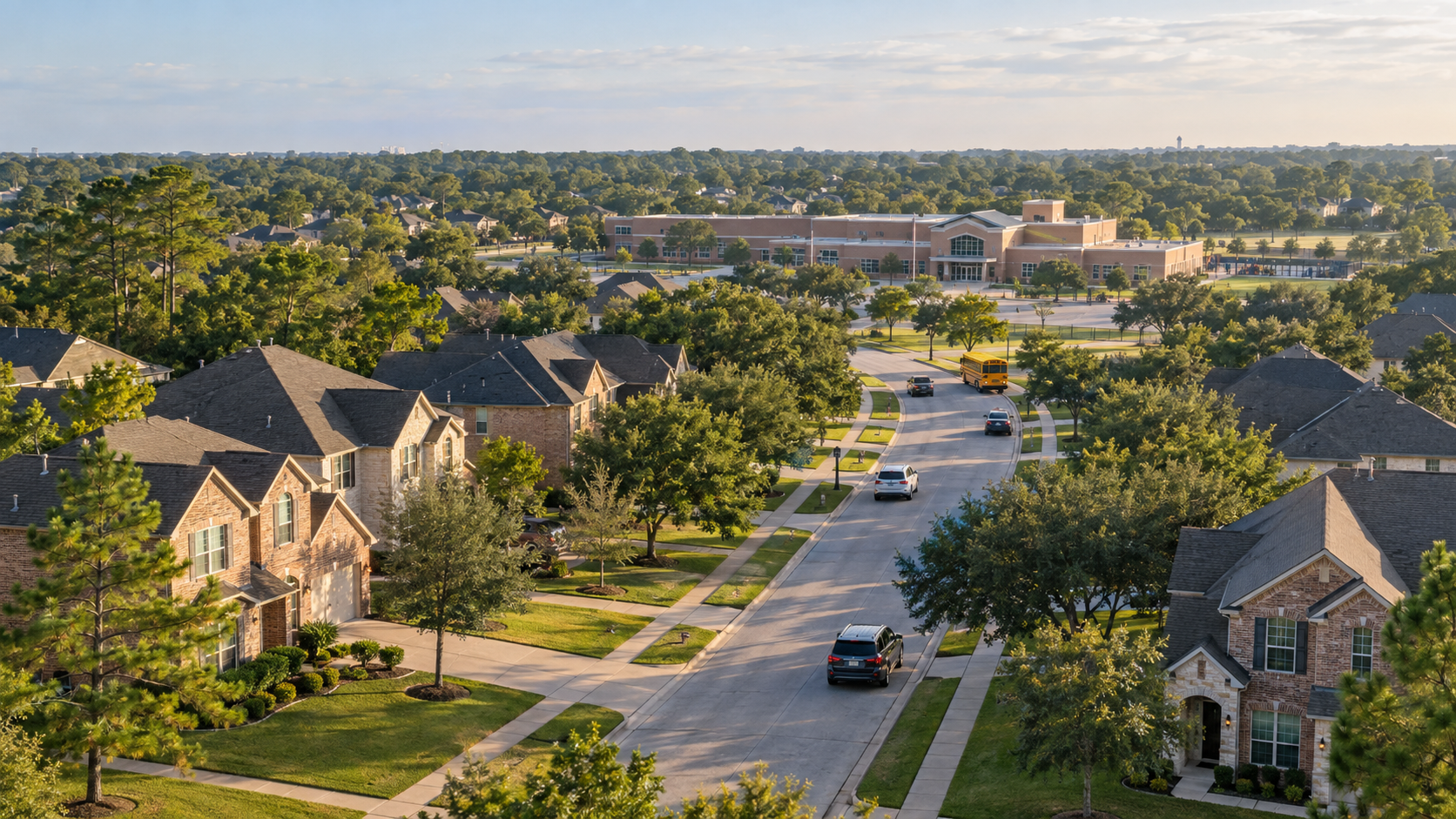
Houston suburbs ranked by schools and commute time

Which Houston suburb has the best schools and commute? It's the question relocating families ask most, and the answer rarely comes from a ZIP code search or a casual scroll through listings. A suburb with exceptional schools might sit 75 minutes from your office on a Tuesday morning, while one with a painless commute feeds a district that consistently underperforms. Neither trade-off announces itself easily. The only way to resolve it is to run two measures side by side: verified school district performance and realistic rush-hour drive times to wherever you actually work.
This guide does exactly that. It pairs 2026 Texas Education Agency district ratings with peak-hour drive estimates to the three largest Houston job centers, Downtown, the Texas Medical Center, and the Energy Corridor, for six suburbs: Katy, Cypress, The Woodlands, Spring, Pearland, and Sugar Land. The framework was shaped by Ashauna Lindo of Greater Houston Real Estate (eXp Realty LLC), a lifelong Houston-area resident who has guided relocating families through this schools-and-commute analysis for over a decade.
How this comparison works: TEA ratings and real commute data
What TEA ratings actually measure
The Texas Education Agency assigns each district an A through F accountability grade based on four components: student achievement, academic growth, closing achievement gaps, and post-secondary readiness. An A means the district is performing in the top tier statewide. A B is solid but carries measurable room to grow. District-level ratings give you a useful baseline, but campus-level scores within the same district can vary significantly. Always drill down to the elementary, middle, and high school tied to your specific address before drawing conclusions.
Why peak-hour drive time beats distance
A suburb 20 miles from Downtown can take longer to reach than one 35 miles away, depending on the corridor and departure time. Google Maps defaults to off-peak estimates, which can understate your actual daily experience by 20 to 40 minutes on Houston's most congested freeways. This guide uses peak-hour estimates (7 to 8 AM inbound, 5 to 6 PM outbound) based on Houston TranStar corridor data and documented congestion patterns on I-10, I-45, US-59, and SH-288. That's the number that actually affects your quality of life.
The three job hubs used as benchmarks
Downtown Houston, the Texas Medical Center, and the Energy Corridor together account for the majority of corporate relocation scenarios in the metro. Downtown anchors finance, legal, and energy headquarters. The TMC is the world's largest medical complex, employing over 100,000 people. The Energy Corridor on the west side hosts major oil and gas operators. The Galleria is referenced where relevant as a secondary benchmark for those working in the Uptown district.
Which Houston suburb has the best schools and commute: quick take by job hub
Before diving into each suburb, here's how they sort by primary job destination:
| Suburb | TEA Rating (2026) | Energy Corridor | Medical Center | Downtown | Median Home Price |
|---|---|---|---|---|---|
| Pearland | A | 55, 80 min | 20, 35 min | 30, 45 min | ~$340,000 |
| Katy | B (88) | 25, 45 min | 55, 85 min | 45, 75 min | ~$385,000 |
| Cypress | B | 20, 35 min | 60, 85 min | 45, 70 min | ~$355,000 |
| Sugar Land | B | 20, 40 min | 40, 65 min | 35, 55 min | ~$365,000 |
| The Woodlands | A/B (mixed) | 45, 70 min | 55, 85 min | 45, 60 min | ~$410,000 |
| Spring | B (mixed) | 50, 75 min | 50, 75 min | 35, 55 min | ~$310,000 |
Katy and Cypress: west-side suburbs for Energy Corridor commuters
Katy ISD: B-rated at 88, strong campus consistency
Katy ISD earned an 88 and a B rating from the TEA in 2026, one of the highest B-range scores in the Greater Houston metro. That score reflects consistent academic performance across a large district, a well-regarded dual-language program, and several individual campuses that outperform the district average. Median home prices in Katy and Cinco Ranch run approximately $385,000, above the Houston metro median of roughly $330,000 to $335,000, but justified by the combination of school quality and location relative to the Energy Corridor.
Cypress-Fairbanks ISD: B-rated, large district with standout campuses
Cy-Fair ISD also holds a B rating from TEA in 2026. As one of the largest districts in Texas, campus-level variance is real. ZIP codes in the northern Cypress corridor and around Jersey Village tend to feed stronger-performing campuses, while areas at the district's edges show more inconsistency. Median home prices in Cypress and Jersey Village sit around $355,000, making it the more affordable west-side option while still landing above the metro median.
Commute reality for west-side suburbs
This is where Katy and Cypress separate themselves from every other suburb in this comparison. Katy to the Energy Corridor runs 25 to 45 minutes at peak hour, a genuine counterflow advantage on I-10 that Energy Corridor commuters feel every single day. Cypress to the Energy Corridor is 20 to 35 minutes via US-290. Both suburbs extend to 45 to 75 minutes into Downtown and 55 to 85 minutes to the Medical Center, making them a poor match for TMC workers.
The SH-99 Grand Parkway is a meaningful bypass for west-side commuters. Drivers in south Katy, particularly the 77494 ZIP code, can trim 10 to 15 minutes off the Energy Corridor trip by routing via Grand Parkway to Westpark Tollway instead of staying on I-10 during peak congestion.
The Woodlands and Spring: north Houston's school reputation tested against commute distance
Tomball ISD and Conroe ISD: the districts behind The Woodlands
The Woodlands is not a single school district, a fact that surprises many relocating families who assume the community name equals a unified school system. Depending on the specific neighborhood, residents draw from either Conroe ISD or Tomball ISD. Tomball ISD earned an A from TEA in 2026, placing it among the highest-performing districts in the metro. Conroe ISD received a B with an overall score of 85, its third consecutive B rating. Families considering The Woodlands must verify their specific address against published attendance boundaries before assuming which district they're in.
Spring: accessing Conroe ISD and Klein ISD
Spring sits at the edge of multiple district boundaries, and buyers here face the same verification challenge. Depending on the neighborhood, a Spring address falls into Conroe ISD or Klein ISD, a distinction that matters because campus performance and resources differ meaningfully between the two. Spring also sits close to the ExxonMobil campus off I-45 North, making it a practical option for north Houston energy sector workers whose daily drive doesn't reach Downtown. Workers in that profile typically see commute times of 15 to 25 minutes to the ExxonMobil campus, compared to 35 to 55 minutes if they're headed further south into the city core.
Commute trade-off: north suburbs pay a distance penalty
The Woodlands to Downtown runs 45 to 60 minutes on a typical peak morning via I-45, one of Houston's most consistently congested inbound corridors. The Medical Center adds another 10 to 25 minutes on top of that. Cross-town to the Energy Corridor lands between 45 and 70 minutes. For families with a primary earner working downtown or at a north Houston employer, the commute is workable. For Energy Corridor or TMC workers, the daily distance compounds fast. Median home prices in The Woodlands and Spring area run approximately $410,000 and $310,000, respectively, the widest range of any pairing in this comparison.
Pearland and Sugar Land: southern suburbs with A-rated districts and shorter Medical Center drives
Pearland ISD: the only A-rated district this close to the Medical Center
Pearland ISD received an A from TEA in 2026, and that rating carries more weight because of where Pearland sits on the map. Its relatively compact district size allows more administrative focus per campus, and community investment in schools is consistently strong. Elementary campus scores within the district range from the high 70s to the 90s, with several campuses scoring between 90 and 97. Median home prices in Pearland and Friendswood sit around $340,000, the closest figure to the Houston metro median of any suburb in this comparison.
Fort Bend ISD and Sugar Land: B-rated but broad and well-resourced
Fort Bend ISD, which serves Sugar Land and Missouri City, holds a B rating in 2026. It ranks among the most diverse districts in Texas, and its size creates the same campus variance pattern seen in Cy-Fair. Communities in the First Colony and Riverstone areas within Fort Bend ISD consistently outperform the district average and are worth investigating at the campus level. Median home prices in Sugar Land sit around $365,000, a moderate premium over the metro median and slightly above Cypress.
Why these suburbs suit Medical Center and Downtown workers
Pearland to the Texas Medical Center runs just 20 to 35 minutes at peak hour via SH-288, the shortest suburb-to-job-hub pairing in this entire comparison. Pearland to Downtown extends to 30 to 45 minutes. Sugar Land to Downtown lands at 35 to 55 minutes, and Sugar Land to the Energy Corridor runs 20 to 40 minutes via US-59. For anyone working at the TMC, Pearland's A-rated schools combined with that drive time represent the strongest overall value in this analysis. It's not a close call.
Matching your job hub to the right suburb: a practical decision framework
Which Houston suburb has the best schools and commute for Medical Center workers
Most families begin their suburb search by looking at school ratings and then checking whether the commute is manageable. Ashauna Lindo takes the opposite approach with relocating clients: anchor first on the job hub and work outward, because most families underestimate how significantly a daily 75-minute commute compounds over a school year. Starting with your office corridor narrows the suburb list fast and prevents the common mistake of selecting a community based on brand recognition rather than verified data.
The six suburbs sort cleanly by primary job destination:
- Energy Corridor workers: Katy first (25 to 45 minutes, B/88 district), Cypress second (20 to 35 minutes, B district)
- Texas Medical Center workers: Pearland first (20 to 35 minutes, A district), Sugar Land as a secondary option (40 to 65 minutes, B district)
- Downtown workers: Sugar Land, Pearland, or Spring depending on price point and school priority, all three land in the 30 to 55 minute range
- Hybrid or multi-site workers: The Woodlands or Cypress, both of which offer access to SH-99 for flexible cross-town routing
Where housing cost changes the calculus
Pearland at approximately $340,000 with an A-rated district is the most efficient combination in this analysis. The Woodlands at approximately $410,000 offers Tomball ISD's A rating and a genuine suburban lifestyle, but it requires honest commute math, particularly for anyone not working in north Houston. Katy at approximately $385,000 with a B/88 rating is the strongest choice for Energy Corridor workers, where the counterflow commute advantage pays off daily. Cypress at $355,000 gives west-side commuters a lower entry price with comparable access to the Energy Corridor.
Your next steps before you commit to a suburb
Four things to do before you sign anything
Research at the district level is a starting point, not a finish line. Before making an offer on any property, work through this checklist.
- Look up the specific TEA campus ratings for the elementary, middle, and high school tied to any address you're considering. District averages can mask significant campus-level variation within the same ZIP code.
- Drive your actual commute route during morning rush hour before making an offer. Peak-hour reality on I-45 or I-10 is different from what any map tool estimates mid-afternoon on a Tuesday.
- Check attendance boundaries directly on the school district's website. Streets within the same subdivision sometimes feed different campuses, and boundaries shift periodically.
- Compare housing costs within each district zone. Price varies significantly by subdivision even within a single ISD, and knowing which pockets offer the best value for your school priorities is a local knowledge advantage.
Why a local advisor changes the shortlisting process
Ashauna Lindo has guided relocating families through the district-and-commute tradeoff across The Woodlands, Katy, Spring, Cypress, Conroe, and Pearland for over a decade. That experience means a single conversation can surface the nuances that weeks of online research miss: which specific Cy-Fair elementary zones outperform the district average, where in Pearland the housing-to-school-quality ratio is most favorable, or which Woodlands neighborhoods sit in Tomball ISD versus Conroe ISD. Reach out to Greater Houston Real Estate (Ashauna Lindo, eXp Realty LLC) for a community consultation tailored to your job location, school priorities, and price range. It's the most efficient move you can make before this search goes any further.
No single Houston suburb wins on every measure, but the right answer comes into focus quickly once you anchor on your job hub and school priority. For Medical Center workers who want top-rated schools at metro-median prices, Pearland is the clear answer. Katy is the strongest west-side pick for Energy Corridor commuters. The Woodlands earns its reputation but demands honest commute math for anyone not working north of Beltway 8. If you're still weighing which Houston suburb has the best schools and commute for your specific situation, a personalized conversation beats another hour on a search portal.
Frequently asked questions: best Houston suburb for schools and commute
Which Houston suburb has the best schools and commute overall?
Pearland offers the strongest combination for most relocating families: an A-rated district (Pearland ISD, 2026 TEA), peak-hour drive times of 20 to 35 minutes to the Texas Medical Center and 30 to 45 minutes to Downtown, and median home prices close to the Houston metro median at around $340,000. For Energy Corridor workers specifically, Katy edges ahead due to its counterflow commute advantage on I-10.
Which suburb is best for Texas Medical Center employees?
Pearland, without question. The SH-288 corridor delivers the shortest peak-hour drive of any suburb in this comparison, typically 20 to 35 minutes, paired with an A-rated school district. No other suburb in this analysis matches both criteria simultaneously.
Which suburbs have A-rated school districts near Houston?
Based on 2026 TEA ratings, Pearland ISD and Tomball ISD (which serves parts of The Woodlands) both hold A ratings. Every other district in this comparison, Katy ISD, Cy-Fair ISD, Conroe ISD, Klein ISD, and Fort Bend ISD, holds a B rating, though individual campuses within those districts can score significantly higher.
Is it worth living in The Woodlands if I work downtown?
It depends on your tolerance for a 45 to 60 minute peak-hour commute via I-45. The Woodlands offers strong schools (particularly in Tomball ISD zones), an established suburban lifestyle, and higher median prices around $410,000. Families who work primarily in north Houston or can work remotely part of the week tend to find the trade-off worthwhile. Daily Downtown commuters should weigh that drive time honestly before committing.
Check out this article next